
A Unique Way to Think & Solve Problems (Get Ahead of 99% of People)

Marketing, on a fundamental level, is communication.
To communicate effectively, you need clarity over your ideas. To have clarity over your ideas, you need to be able to think.
Most people don’t know how to think. Worse yet, they outsourced their thinking to an algorithm.
The quality of your life is determined by the quality of your thoughts. Your thoughts literally dictate your reality; they are how you process and internally perceive everything that you experience.
The quality of your thoughts is directly correlated to the quality of your actions. This is because everything you do dictates your internal dialogue and the stories that you tell yourself.
I’ve noticed something interesting. People make the wrong choices because they view things in isolation. When they make undesirable decisions, they start to develop internal fear, uncertainty and doubt across everything that they attempt to do or accomplish.
This negative feedback loop starts with poor decision-making. This is how it plays out for the majority. They make a decision that doesn’t factor in the greater whole. It has negative consequences. Next time they make a choice, they are afraid of the negative consequence, which lead to timid decisions that will reduce perceived risk. Usually, this leads to more negative consequences and a negative flywheel starts to gain momentum.
Thinking in isolation often leads to awful decisions because it ignores a universal principle called omnipresence. This creates a cascade of unintended consequences by accounting for X, while completely overlooking Y and Z.

Newton's Third Law
For every action, there is an equal and opposite reaction
Your thoughts influence your decisions and your decisions impact your actions. Your actions impact the quality of your life, the depth of your relationships and the success of your business. If everything is weighed on our train of thought, we need a clear framework for thinking and problem solving that we can use as a guiding light.
There's a term that I refer to called Omnipresence/Omnipresent.
Often when I mention this term, it gets confused with an omni-channel marketing approach. That’s one part of it…
Omni-channel marketing is a phenomenal framework which creates mere exposure & turns cold strangers into loyal clients (fast)
But when I talk about Omnipresence, I am actually referring to a universal principle that I accidentally picked up by studying and paying attention to multiple disciplines.
The thing is I’m not a marketer. I’m a business owner. More importantly, I’m a student of life.
When I research and study, I absorb information and look for patterns. When I find patterns across multiple areas, I label them universal principles.
I am always hunting for these guiding principles because I believe they are the keys to success.
What do I mean by Omnipresence?
Omnipresence is the awareness that everything is connected.
The finer details make up the bigger picture
For example, in the digital marketing space, it’s common practice for agencies to sell or specialise in siloed services.
- Web design
- Google ads
- Meta ads
- Branding
- Social media marketing
- Search Engine Optimisation (SEO)
- Conversion Rate Optimisation (CRO)
When I ask my client partners or prospects what the end goal of marketing is? They usually say to generate predictable revenue, build trust & create awareness for their brand.
To reach that end goal, we need to factor in that the website is correlated directly to your SEO. Your SEO is directly correlated to your ads. Once people land on your website from the SEO, we want them to take an action, which is correlated to Copywriting (the art of communication and persuasion).
What makes this idea powerful is that it is a recurring pattern.
It shows up across almost every single domain I’ve studied. When a pattern shows up across multiple fields, we need to pay close attention.

Note
When patterns show up in business, behaviour, or markets, you need to focus and pay attention
Omnipresence is a universal principle.
When you implement this way of thinking, you gain a massive advantage:
- You are able to diagnose & focus on things that are going to move the needle
When you factor in the greater whole (omnipresent), you gain perspective and clarity
To completely grasp and internalise this principle I want to explore how it impacts sound and biomechanics. Two fundamentals that we experience daily.
Let’s look at how it dictates how we perceive sound.
How we perceive sound and the frequency spectrum
I first noticed this pattern in a physics class whilst I was studying audio engineering.

My lecturer, Professor Thomas, was describing waveforms and frequencies.
At one point, he explained:
"Sound is just physical atoms moving up and down, vibrating through the room."
That clicked something for me. Sound isn't abstract; it's matter in motion. It was one of those “aha” moments. I realised that I had been listening to music passively for over 20 years.
Note
Sound has a human-audible frequency band from 20hertz to 20,000hertz
Sound is air molecules compressing and expanding at a specific frequency, hitting your body with enough force that you can feel.
Later, in a mixing class with Tok Norris, I learned the practical application of this principle.
He was showing us how to mix low-end frequencies. He explained that if you cut the high frequencies in a sound, the bass doesn't disappear. It's still there. But it alters the sound of it and creates a muddy, undefined, weak sound. You can turn up the bass as loud as you want, but it won't make it more pronounced.
The problem is that you removed the harmonics.


The Harmonics Principle
The fundamental frequency is what you feel. The “bass” or as some like to say the low end. That’s what’s pounding your chest when you’re dancing at a nightclub. The harmonics are what you perceive. The presence and definition.
Cut the harmonics, and the bass turns muddy and weak. You have to restore the harmonics first. Only then does the bass sound phat.
Everything is connected and part of a greater whole. What you do in the higher frequencies alters the perception of the lower frequencies.
There’s another universal principle worth noting related to audio engineering
When it comes to recording sound, the quality of the sound source is paramount. You can't fix a bad recording in the mix with expensive gear. Your raw input strictly limits your final sound.
This principle applies to almost every system in life:
- Business: The quality of your web traffic matters far more than raw numbers. 100 highly targeted visitors will always beat 10,000 random clicks.
- Nutrition: A calorie isn't just a calorie. The metabolic foundation you get from 300 calories of organic, grass-fed beef is entirely different from 300 calories of a McDonald's hamburger.
- Thoughts: The quality of the stories you tell yourself and how you problem solve dictate your reality

The quality of your source material determines your final output.
Let’s shift our attention to biomechanics and facial symmetry. The next section has the potential to change the quality of your life.
The body is an integrated system (Breathing and biomechanics)
The body proves this principle at a deeper level.
The best example of this is your face. It's the sum of decades of “invisible” inputs. Very few know this, but your breathing and tongue posture play a crucial role in how your skull and face develop.
Society is taught to be reactive. You have a headache, you take a Panadol. You have high cholesterol, you go get a statin.
The medical industry treats biology like a checklist. You have a symptom; that’s ok, just take this pill, and you’ll forget about the pain.
But the body doesn't process changes in isolation. Everything is connected, and small micro actions turn into habits that, repeated daily, compound whether you're aware of it or not.
Just like sound waves, the body is not a collection of parts. It is an integrated unit.
Something that feels so invisible has a profound impact on how we look and how we experience life - breathing

How you breathe has an enormous impact on how you look, the development of the body and overall quality of life. This is clearly illustrated in the image above. The boy who developed a blocked nose went from nose breathing to mouth breathing.
You can see that his face lengthens and the jaw has receded. The focal point isn’t cosmetic, though how you breathe can create asymmetry in the face and body. This structural issue has a deep impact on breathing mechanics and leads to underdeveloped airways.
Mouth breathing changes the shape of your face. The "mouth breathing twins" study is proof: similar genetics but different breathing patterns that resulted in different facial development. One twin breathed through their nose. The other breathed through their mouth. Over time, the mouth breather's face elongated, their jaw receded, and their airway narrowed.
Different input = different outcome.

These things feel invisible and insignificant, but they have a profound impact on you. Nobody looks at someone's face and thinks, "great tongue posture." But tongue posture & breathing mechanics literally build the face.
The body is a unit where everything is connected.
Marketing & acquisition strategy (You have to be omnipresent)
"A system is never the sum of its parts; it's the product of their interaction." — Russell Ackoff, organisational theorist and pioneer of systems thinking
We’ve discussed how finer details are connected within sound & biomechanics.
Let’s look at how this relates to your business. In particular, acquisition and marketing strategy.
A good way to view your business is like a system. There’s a lot of moving cogs, and you want the cogs moving in unison and symmetry.
Think of it like components of a Rolex

Acquisition and marketing are the equivalent of the mechanics explained above. The thing is, very few marketing practitioners are aware of this notion. Even fewer business owners can grasp this concept.
When you optimise one part of a system without understanding how it connects to the rest, you don't improve the system or get to your desired result.
What happens is that you just shift the bottleneck somewhere else. This is the result of surface-level thinking, which leads to mid outcomesn at best.
Let’s explore some common examples in the digital marketing space and how they negatively impact businesses because they neglect an integrated, omnipresent approach.
Example 1: “Award-winning” websites
This example comes to mind. Just this week, I was sitting down with a very ambitious business owner who was dealing with this issue. He had a beautiful custom-coded website that cost him $2K+ every time he wanted to make structural changes. Furthermore, he had issues uploading images via the content management system (CMS).
The website was not indexed properly, and you couldn’t even find the home page via a direct-match navigational search (branded search).
Days and weeks have been poured into this asset, not to mention tens of thousands of dollars. Only for it to miss the mark with the end user & be confined to page whatever of Google.
I speak to C-suite leaders and business owners daily. I am consistently auditing businesses, whether it’s through Zoom meetings or on the treadmill at the gym.
A common problem businesses fall into is investing in a website that is a glorified brochure with no visibility.
This happens because they go to an “award-winning” web design agency. They get sold on this beautiful design that only really benefits the agency. They win the award, and the business pays in lost revenue and minimal return on investment.
I don’t want to put the blame on these agencies. They’re designing beautiful work; the problem is that they don’t know any better. They’re designers. What most businesses think they want and what they actually need are two different things.
Look, don’t get me wrong…
The website has to be aesthetic. It has to look and feel premium; that’s a prerequisite.
But it also has to have foundational Search Engine Optimisation (SEO) & Conversion Rate Optimisation (CRO) embedded at its core; otherwise it’s useless. This has to be done whilst the website is being built; otherwise you’re having to fundamentally rebuild the website once it’s been designed and developed. This is because SEO is directly correlated to the website. Your SEO directly links to your Google Ads performance.
The mistake that businesses make is investing in the website as a single entity. Then once that’s done, they’ll engage an SEO agency to do “SEO”. This costs you time and a lot of money in terms of outgoings and potential earnings.
Example 2: Focusing on one channel for acquisition
In 2010, you could get away with this approach. Focusing solely on just SEO, Meta or Google is not effective in 2026 moving into 2027 for the large majority of businesses (there are exemptions)
As time moves along, markets increase in sophistication. Many entrepreneurs aren’t aware of this, but markets grow and evolve. As markets develop, the consumer's buying psychology transforms.
The reason why is that, initially, people were open to buying things from strangers on the internet; also, the geopolitical and macroeconomic situation was a lot more palatable (Especially for Western countries).
Today, a lot of that trust has been abused by bad actors. Furthermore, the macroeconomic and geopolitical situation has worsened. All of this has led to high levels of scepticism and fear.
Far from ideal conditions for trade and transactions.
Something else worth noting is that the internet is hyper-connected. The way algorithms deliver information has completely changed.
When software companies start, they are very generous with:
- Organic reach
- Features
- Pricing
This is because they want to bring on as many people onto the platform as possible. Once they have the users, they have data, and that gives them leverage. In the early days of Google, there weren’t that many ads in the search results. That’s because Google was trying to acquire users. Once they got the user base and people became hooked, they started to monetise their data.
If big platforms are making 90% of their revenue from ads, guess what that means? Organic reach becomes de-prioritised & downgraded.
The same thing happened on Facebook…
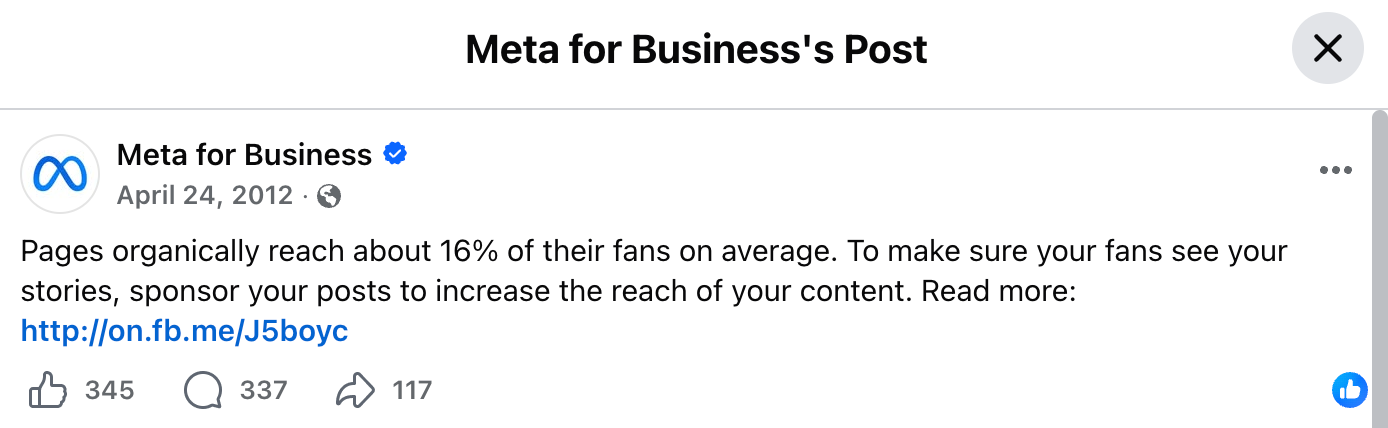
In 2012, business pages on Facebook had 16% organic reach (Not great, but still it was something). Today, business pages have about 1% organic reach. Facebook & Instagram are pay-to-play platforms. That’s no secret.
If you’re a business owner who wants to succeed and live a life of abundance, you have to understand 3 things:
- Big platforms have their own interests at heart
- It’s almost impossible to have stability in a business without a paid media strategy
- You’re not just competing with people in your industry; you’re competing with the Nikes & Apples
A lot of business owners I speak to live under a false pretence, thinking that if they post organic content, they can grow. The thing is, they won’t even reach their own followers…
The customer journey has become elongated, and attention spans are fragmented. This is especially true for any product or service over $1,000 dollars.
The modern buyer journey isn't linear. It's spread across multiple platforms.
A prospect might see your ad on Instagram, Google your name three days later, read a review on your local listing, read a testimonial, check your LinkedIn, and then might fill out a form. Something that is very rarely spoken about is that multiple touchpoints don't just support the sale; they compress the timeline. Each time your audience sees you online, you create familiarity.
Familiarity breeds trust.
The reality is that 97% of your prospects aren't ready to buy today. Not because your offer is weak, but because they haven’t had enough time to make a discerning decision.
This is where most businesses fall short.
They run some “ads”, get a few leads, and if someone doesn't convert on the first call, they follow up once and move on to the next tactic. But that person is still comparing; they’re still deciding.
Businesses that get the sale are the ones that build trust. To create that relationship and familiarity, you need to trigger mere exposure, and to do that, you need to have multiple touchpoints.
Example 3: Mismatch of intent & relevance
This is a fundamental pillar of success. Most marketing screams and shouts. They hold a megaphone to their prospect, screaming: “BUY MY SH*T!!!!!”
Let's break down what happens when your ad and your landing page aren’t congruent.
Imagine an ad promising a free consultation. It's a low-commitment offer, so your prospect clicks without hesitation. But when they land on the page, they're shown a $5,000 package with no explanation of how they got there. There's no bridge between what was promised and what's being delivered.
To understand why this fails, we need to explore 2 things:
- How your prospect perceives this mismatch of intent
- How the algorithm perceives this lack of relevance
1. What's happening psychologically
The human brain relies on consistency to judge safety and trust.
This is the same mechanism behind the halo effect; first impressions form in milliseconds, well before conscious reasoning comes into play. When a promise and its delivery don't match, that inconsistency gets processed the same way any broken pattern does: with caution and doubt.
Your prospect isn't consciously thinking "this looks like a bait and switch." They simply feel uneasy, and leaving the page is their natural response.
Remember it’s all about how your prospect feels.
This connects back to a principle called the horn: one flaw outweighs several strengths. A well-written ad and a well-designed landing page can each be excellent on their own, but if the transition between them is broken, that gap undermines both.
2. What's happening algorithmically
Platforms like Google and Meta don't stop measuring performance once someone clicks your ad. They track events and behaviour:
- Bounce rate
- Time on page
- How many times someone clicks
- Whether they fill in a form or click to call
These signals feed into what's called a Quality Score or Relevance Score, which determines your cost per click. This is relevant to Google Ads. But this also relates to organic visibility & SEO / GEO.
Here's the chain of cause and effect:
- A mismatched message and landing page produces poor engagement signals
- Poor signals lower your Quality Score
- Your website gets deprioritised
- Your cost per click increases
- A higher cost per click reduces your reach
- Reduced reach means the algorithm collects less data
- With less data, the algorithm can't optimise your campaign effectively
So a mismatch doesn't just cost you a lost client. It fundamentally teaches the algorithm that your brand and business are irrelevant to your target audience. This means your commercial assets underperform and that negative feedback loop compounds across every future impression.
This is how businesses suffocate.
The foundational principle
Both our brain and the advertising algorithm are, in their own way, pattern-matching systems.
One operates on evolutionary instinct built over hundreds of thousands of years. The other operates on aggregated behavioural data collected in real time. But both are asking the same question:
Does this experience hold together as one coherent thing?
Your ad and your landing page function as two connected links in a single chain. If that connection breaks, the strength of everything else in the chain dissolves.
Note
The scientists training these systems didn't invent a new way of judging trust and relevance.
They fed it millions of human decisions, clicks, bounces, time spent, and asked it to find the pattern.
Let’s look at one more example, and then I’ll give you a framework on how you adopt and apply omnipresence to your decision-making process.
Example 4: Isolated “tactics”
Even when agencies offer full service, they still treat every channel like it’s an isolated entity.
A business hires an agency that offers
- Web Design
- Google Ads
- Meta Ads
- SEO
On paper, this looks comprehensive; it covers all the major channels.
But offering multiple services isn't the same as integrating them and making them hum.
I have literally sat in rooms with agency owners saying, “we offer everything but we could do a much better job at making the channels work together”.
In practice, what usually happens is that each channel isn’t integrated to complement the other. They run in parallel rather than in unison.
For instance, the focus on SEO isn't to rank for “keywords”. What you actually want is to come up for commercial queries where the user has purchase intent. Those same pages become the destination for Google Ads, so paid traffic and organic traffic reinforce the same asset. Every dollar spent on ads strengthens the page's engagement signals, which supports its organic ranking.
The ranking and the ad spend compound each other instead of having one landing page to run Google ads to and a keyword strategy that’s going to “rank”.
The blog content that supports those landing pages doesn't just generate organic traffic either. It becomes source material for Meta ads. The pain points, objections, and proof points already tested in the blog get repurposed into ad creative that's been pre-validated by what the audience actually engages with. Instead of guessing what will resonate, the paid team is adapting content that's already proven to work.
Everything is done and executed with intent. This creates momentum, a positive feedback loop that compounds.
A simple way to think & help you make future-proof decisions (Become dangerous)
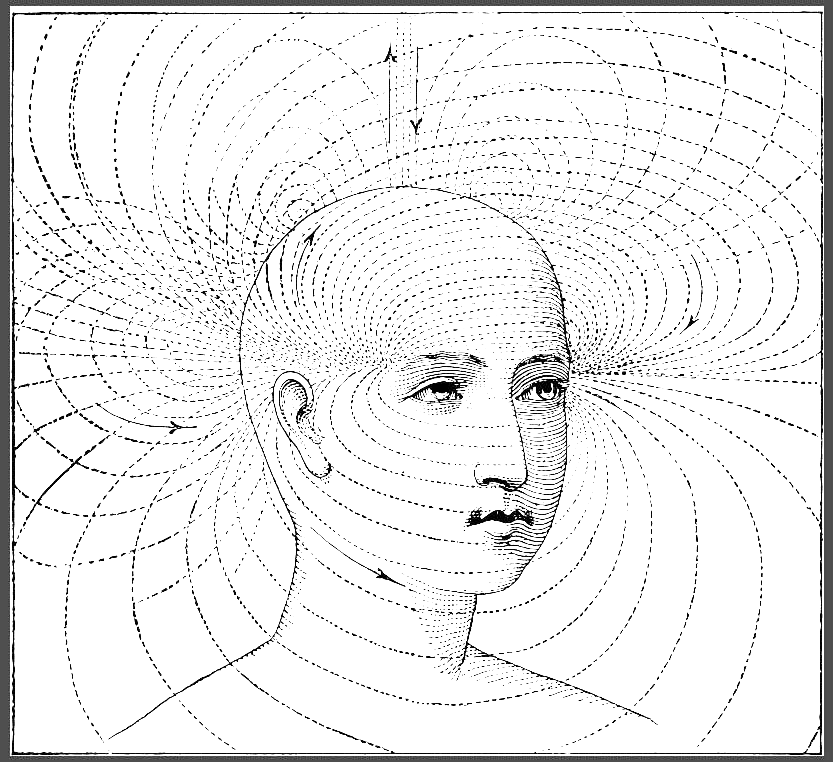
1. First principles thinking
First principles thinking is stripping things down and looking at them from a very foundational or rudimentary level.
Challenge past assumptions and get to the absolute core.
Break things down to their bare basics.
Here are some examples of first principles thinking applied to themes we covered in this article:
Biomechanics & facial development
People think that how you look is based on genetics. First principles allow us to go beyond the surface and realise that your jaw and facial symmetry are by-products of two habits. Breathing and tongue posture. Facial development and overall aesthetics are a byproduct of health, not genetics.
Nutrition
Fitness gurus on YouTube will tell you that you can eat whatever you want because a calorie in is a calorie out. First principles allow us to see that 300 calories from organic gras fed beef has a completely different metabolic and hormonal reaction than 300 calories of refined sugar and processed canola oil.
Web design
A common fallacy that leadership falls into is thinking that an award-winning website is going to generate revenue by being visually striking and catching the eye. First principles give us the awareness to ask what the website is actually used for. 99.9% of the time, business owners want to generate revenue. Therefore, we can conclude that the website is useless if the site isn’t built with SEO, has poor message clarity and doesn’t have logical steps to take action.
SEO
It’s common for SEO practitioners to focus on keyword volume and “traffic” to the website. First principles ask: what is the quality of the traffic? Not all traffic is made equal. Are we going after commercial and transactional keywords, or are we just going for informational keywords with search volume?
Google ads
Conventional thinking with Google ads is that if you pay Google money for the “keyword”, you will get sales. First principles reveal that Google is after its own interests. To generate alpha on Google, you have to align your website, content and landing page experience to match how Google delivers information.
In short, first-principles thinking is breaking things down to their absolute truths and reverse-engineering from there.
2. Reverse engineering
First principles allow us to break problems down to their bare components. Reverse engineering lets us build back up and prioritise our chain of actions.
First principles paired with reverse engineering give you incredible depth in your train of thought. Most mistakes happen because you have a gap in your reasoning. A deficit of comprehension… These two mental models close those gaps and fill the space with certainty.
Poor decisions stem from 2 gaps
- Unable to view the problem from a holistic perspective
- Unsure of the next logical step to solve that problem
First principles close the first gap. It strips away assumptions until you're seeing the problem at face value, not masked by what you’ve heard or how you feel.
Reverse engineering closes the second. It allows you to create the exact sequence of steps backward from the outcome you want, so you're never guessing at what’s next.
Once you close these 2 gaps, there’s only one question left? Where do you actually allocate your time and resources?
That leads into our 3rd step in our framework
3. Isolate & prioritise the weakest link
The chain is only as strong as its weakest link. The first 2 points are useless if you don’t concentrate your efforts and prioritise the weakest part of the chain. You have to isolate your efforts and prioritise your actions. Think of it like levels in a video game; you don’t just get to fight Ganondorf and save Zelda; you have to run through Hyrule and unlock the dungeons.

How do you isolate and prioritise the weakest link?
Think about the downstream events. You need to be tapping into first principles and reverse-engineering concurrently. This will allow you to unlock a heightened level of omnipresence.
You need to have a long-term time horizon (Essential)
“Play long term games with long term people. All returns in life, whether in wealth, relationships or knowledge come from compound interest” - Naval Ravikant
Perception lag is something that causes many people to become stuck and frustrated in one place, never really moving past their hurdles and living in their own version of Groundhog Day.
You have to factor in time… Domino effects need space to unfold.
Remember the tongue posture example. The tongue is a natural retainer, and it applies pressure to the mid-bone daily (24 hours a day). It takes years for the skull to develop properly. Your mid-bone opens up your airways and allows you to breathe deeper through your nose. Superior breathing remodels your hormonal profile, and this consistency over time is what builds a healthy structure that triggers the halo effect.
The timespan is part of the problem and the solution.
Critical thinking is more important now than ever (You have to go against evolution if you want to stand out and succeed)
If you pay attention to what’s going on online, you’ll notice that everyone is fixated on tactics and short term thinking. This gives the small percentage of people willing to use their brain a huge opportunity vehicle.
Humans didn’t evolve to be at the top of the food chain because we had amazing physical prowess or brainpower; it was a unique ability to selectively imitate individuals and share knowledge across massive social networks.
Think about it: in the African desert, testing hunting techniques was dangerous and could lead to death. We evolved by creating a shortcut. Identify the highest-level group member and copy their exact method.
This is how we overcame Neanderthals, who traditionally had way more strength and bigger brains. The term for this is prestige bias.
Why is prestige bias a problem in the age of AI?
This evolutionary bias that we inherited is causing the large majority of businesses to commoditise and blend in with their competition. Short-term tactics lead to:
- Higher costs to acquire clients
- Price-sensitive leads
- No certainty
- Zero differentiation
- Generic messaging
This is why you have to be omnipresent
Infinite awareness allows you to see everything so you can focus on one thing
Everything is connected.
Think about it: everything in our world is part of a massive, ongoing recycling system built from atoms.
These atoms form the air around us, creating a physical ocean of invisible particles that fills our lungs but also vibrates to carry the sound we hear.
The cycle begins when plants pull atoms of carbon and oxygen from the air, using sunlight to grow.
This builds the foundation of our ecosystem; as animals eat those plants, and others eat them, they are physically passing those very same atoms up the food chain to sustain all life and organisms (including us). Eventually, through the breath we exhale and the natural breakdown of living things into the soil, those atoms are released right back into the environment.
The exact atoms carrying the sound of today and that make up your body and breathe once belonged to oceans, and will one day build the life and organisms of tomorrow.
Being omnipresent will give you 3 things most people chase throughout their lives
Clarity
When you strip your problems using first principles and reverse engineer, you remove doubt and have certainty in your decision-making. You stop guessing
Compounding results
When you treat everything as a single unit (an ecosystem), your efforts stack up and compound.
Differentian
Whilst the majority chase shiny objects and the latest “playbooks”, you will stand out by focusing on and looking at the whole system. This will allow you to move in your own unique way by acting on things that drive outcomes. This will allow you to craft a category of one.
None of this requires you to do more. You just need to zoom out and see more; by doing so, you direct your effort with intention to the thing that’s going to make the difference.
That’s what makes the difference.
That’s how you attract and Mesmerise.
Become omnipresent and unlock your full potential.
Frequently Asked Questions
Founder of Mesmerise, a state of the art full service marketing agency.
We don't just run ads... we build trust and turn strangers into loyal customers.
Attention is fleeting, trust is not...